Six months ago, “GEO” meant absolutely nothing to 95% of marketers. These days, it feels like every LinkedIn post, agency newsletter, and anxious client slack message is asking the same thing: is SEO dying, and do I need to throw money at something called generative engine optimization instead?
Short answer: no, SEO isn’t dead. Long answer: the internet just split into three different games, and you’re now playing all of them whether you meant to or not.
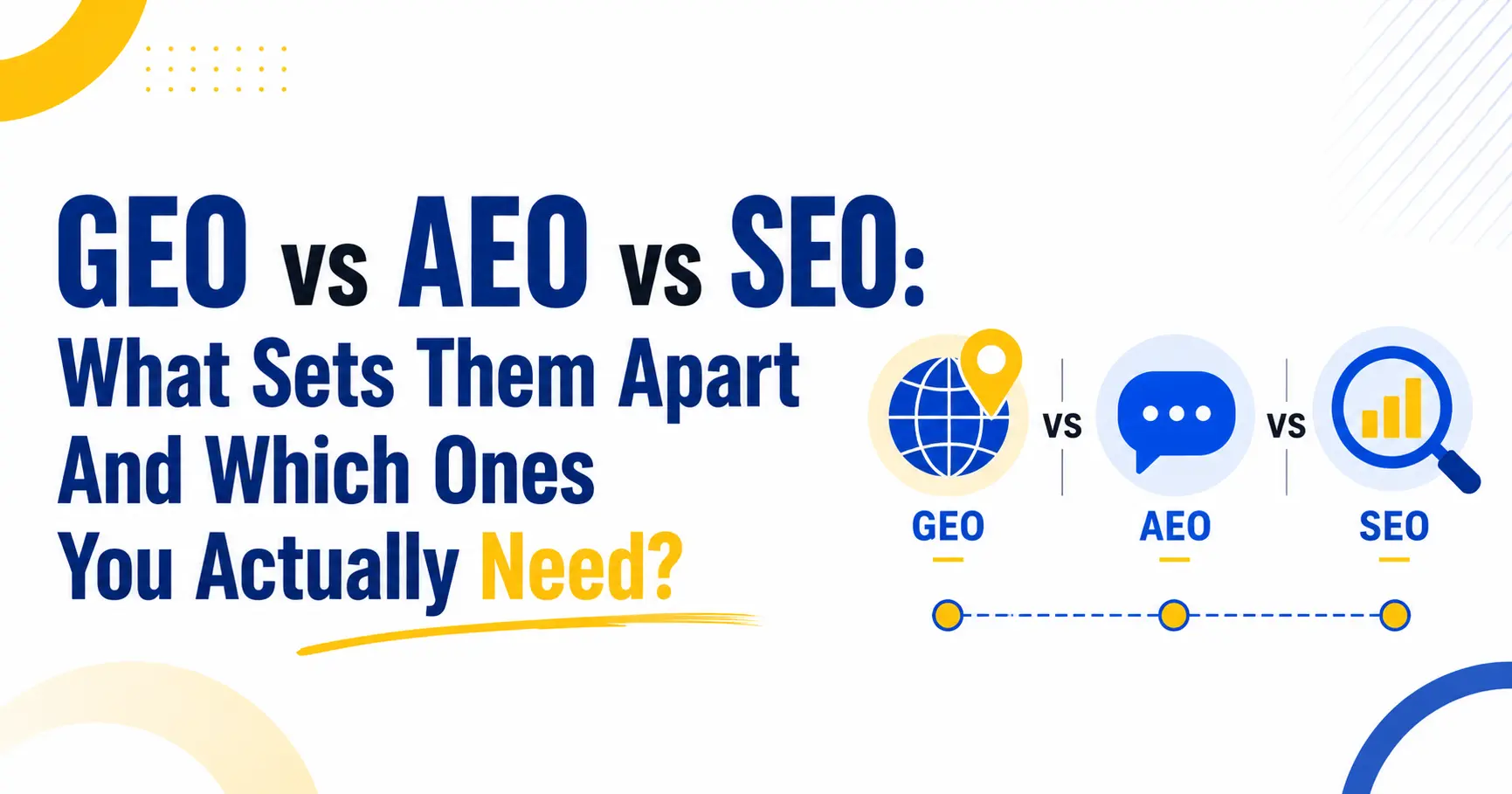
Here’s the thing nobody’s explaining clearly enough, GEO, AEO, and SEO aren’t competing strategies. They’re three different rooms in the same house, and each one has its own rules for who gets let in. Google still sends people to your website. Tools like ChatGPT and perplexity tend to summarize your content rather than sending users to your link. Google’s AI Overviews sit right at the top of search results and answer the question before anyone even scrolls down. If your content strategy only accounts for one of these, you’re leaving traffic, and revenue, on the table for the other two.
Let’s break down what’s actually different, what’s actually the same, and whether your business genuinely needs to care about all three or if that’s just agency fear-mongering.
What Is SEO, Actually (A Quick Refresher)
You already know this one, but let’s set the baseline. SEO, or search engine optimization, is the practice of getting your website to rank on traditional search engines like Google and Bing. It’s built on keywords, backlinks, page speed, technical structure, and content that satisfies what Google calls E-E-A-T, experience, expertise, authoritativeness, and trust.
SEO’s whole job is simple: earn a click. You rank, someone sees your blue link, they click through, they land on your site. The entire model depends on that click happening.
That model is exactly what’s under pressure right now.
What Is AEO? (Answer Engine Optimization)
Answer engine optimization is the practice of structuring content so it gets pulled directly into a direct answer, think featured snippets, “People Also Ask” boxes, voice assistant responses, and increasingly, the AI-generated answer box sitting at the top of Google.
AEO isn’t new, exactly. It’s basically the evolution of “how do I win the featured snippet”, a battle content teams have been quietly fighting since 2015. What’s changed is the stakes. Featured snippets used to be a nice bonus. Now, AI Overviews and voice search have made “getting quoted” almost as important as getting clicked.
The content that wins here tends to share a few traits:
- Direct, front-loaded answers, the first sentence under a header actually answers the question, no throat-clearing
- Clear structure, numbered steps, defined terms, short paragraphs an algorithm can lift cleanly
- Schema markup that tells search engines exactly what type of content they’re looking at
Even the top organic ranking won’t necessarily land you a spot in the answer box. AEO is its own separate fight.
What Is GEO? (Generative Engine Optimization)
Now here’s the one making everyone nervous. Generative engine optimization is the practice of optimizing content to be cited, referenced, or summarized by generative AI tools, ChatGPT, Perplexity, Google’s Gemini, Claude, and whatever else launches next quarter.
This is genuinely a different animal than SEO or AEO, for one big reason: there’s no results page to rank on. When someone asks ChatGPT “what’s the best CRM for a small agency,” there’s no page of ten blue links. There’s just an answer, built from whatever sources the model decided were trustworthy enough to pull from. You either got cited, or you didn’t exist.
GEO is less about keyword density and more about being the kind of source an AI model trusts enough to quote. That tends to mean:
- Original data, research, or first-hand experience, not recycled summaries of other people’s content
- Clear, well-organized information that’s easy for a model to extract and attribute
- A strong presence across the web, mentions on Reddit, review sites, forums, and other sources these models lean on heavily
- Genuine topical authority, built over time, not gamed in a week
We talked to a content strategist who’s been knee-deep in this shift for the past year, and her take was blunt: “Clients keep asking us to ‘do GEO’ like it’s a checkbox. It’s not a checkbox. It’s what happens when your SEO, your brand mentions, and your actual expertise are all pointing the same direction at once.”
GEO vs AEO vs SEO: The Actual Differences
Let’s put it side by side, because this is where most explanations get muddy.
SEO wins you a click on a search results page. It’s measured by rankings, organic traffic, and conversions from that traffic.
AEO wins you a spot inside a direct answer, a snippet, a voice response, an AI Overview box. It’s measured by snippet ownership and visibility, even when no click happens.
GEO wins you a citation or mention inside an AI-generated response, on a platform that may never send anyone to your site at all. It’s measured by brand mentions and citations across AI tools, a much fuzzier, newer kind of tracking.
The uncomfortable overlap: a page can rank #1 for SEO, get pulled into an AI Overview for AEO, and still never get mentioned by ChatGPT for GEO. They’re related, but none of them guarantees the other two. That’s the part most “SEO is dead, GEO is the future” hot takes conveniently skip.
Do You Need All Three?
Depends on where your customers are actually searching, which, for most businesses in 2026, is now split across all of it.
Here’s a simple gut check:
- If you’re an e-commerce or local business where people still type “best plumber near me” into Google and click through, SEO carries most of the weight. AEO helps you win the map pack and featured snippets. GEO matters less right now, but it’s growing.
- If you sell something people research heavily before buying, software, financial services, healthcare, anything considered, people are absolutely asking ChatGPT and Perplexity to “compare” or “recommend” before they ever touch Google. Skipping GEO here means losing the exact moment someone’s deciding who to trust.
- If your business lives or dies by informational content, blogs, guides, resources, AEO is your low-hanging fruit. You’ve likely already got the content; it just needs restructuring to get pulled into answer boxes.
The honest answer for most brands: you don’t need to pick one. You need a content strategy built so the same well-researched, genuinely useful page can perform across all three at once. A well-written, well-sourced, clearly structured article doesn’t need three separate versions, it needs one version done properly.
How to Actually Optimize for AI Search (Without Losing Your Mind)
You don’t need to rebuild your entire content operation overnight. Start here:
- Answer the question in the first two sentences. Save the buildup for later, AI tools and snippet algorithms both reward directness.
- Use real numbers, real research, real examples. Generic advice gets ignored by AI models the same way it gets ignored by readers.
- Structure with headers, bullets, and short paragraphs. This isn’t just readability, it’s literally how these systems extract and attribute information.
- Build a presence beyond your own website. Reviews, forum mentions, third-party citations, these all feed the models that power ChatGPT-style answers.
- Keep publishing consistently. GEO and AEO both reward brands with an established pattern of authority, not a single viral post.
None of this replaces solid SEO fundamentals. It builds on top of them.
The Future of SEO With AI Isn’t Extinction, It’s Expansion
Here’s the honest read on where this is going: search isn’t disappearing, it’s fragmenting. People still Google things. They also ask ChatGPT. They also read the AI Overview without scrolling further. Your content now has to earn its place in three different rooms instead of one.
The brands treating this as a threat are going to spend the next year scrambling. The brands treating it as one more place their expertise needs to show up are going to quietly outperform everyone else, because at the core, none of this has actually changed the fundamental job of content: be genuinely useful enough that something, or someone, wants to point people toward it.
That part never goes out of style.